1. Saving a Workbook in *.xlsx / *.xls / *.xml Format
Use File → Save As and choose Excel (*.xlsx, *.xml) from the File of type list.
Note (1):
As of version 20.0, table references defined inside worksheets are not yet supported. Formulas such as:
=Meals[[#This Row],[Budget]] - Meals[[#This Row],[Actual]]
are loaded and saved with their values, but they are not recalculated.
Note (2):
Although old *.xls files are still supported, if they contain formulas, GS-Calc loads and saves only formula values.
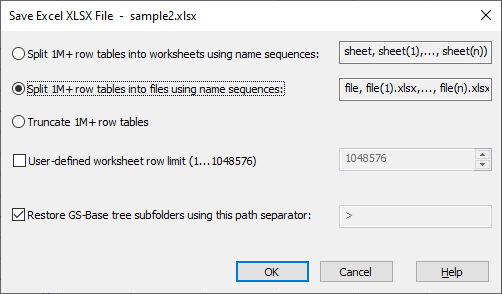
1.1 Save Options (Save Excel XLSX File Dialog)
-
Split 1M+ row tables into Excel worksheets
(sheet, sheet(1), …, sheet(n))
If selected, sheets exceeding Excel’s row limits (1M for *.xlsx, 65K for *.xls) are split into multiple worksheets. -
Split 1M+ row tables into Excel files
(file.xlsx, file(1).xlsx, …, file(n).xlsx)
Sheets exceeding Excel row limits are saved into multiple Excel files. Previously saved files with higher indices are deleted. All files share identical sheet structures. Sheets with fewer rows are saved as empty sheets in subsequent files.
When opening file.xlsx again in GS-Calc, all partial workbooks are automatically merged. -
Truncate 1M+ row tables
Rows above Excel’s limits are not saved. -
User‑defined worksheet limit
Allows specifying a custom threshold (1 to Excel’s row limit) for splitting sheets when saving *.xlsx files. -
Enable restoring the GS-Calc folder structure […]
If selected, Excel sheet names are generated using full GS-Calc sheet tree paths, allowing GS-Calc to reconstruct the original folder structure when reopening the workbook back in GS-Calc.
Since “\” cannot be used in Excel sheet names, it is replaced with “>”.
2. Opening a GS-Calc File Saved in *.xlsx / *.xls Format
Use File → Open and choose Excel (*.xlsx, *.xls) from the File of type list.

3. Related Topics
GS-Calc *.gsc and ODF *.ods files
Excel (*.xlsx, *.xml) files
PDF files
Text files (*.csv, *.txt, *.tab ...)
Text *.zip archives
GS-Base (*.gsb) files
dBase/Clipper/FoxPro files
SQLite (*.db) files
MySQL (*.sql) files